Within the space of one week, we’ve received two positive reports from government level, that point towards a positive future for Lived Experience Recovery Organisations like ours.
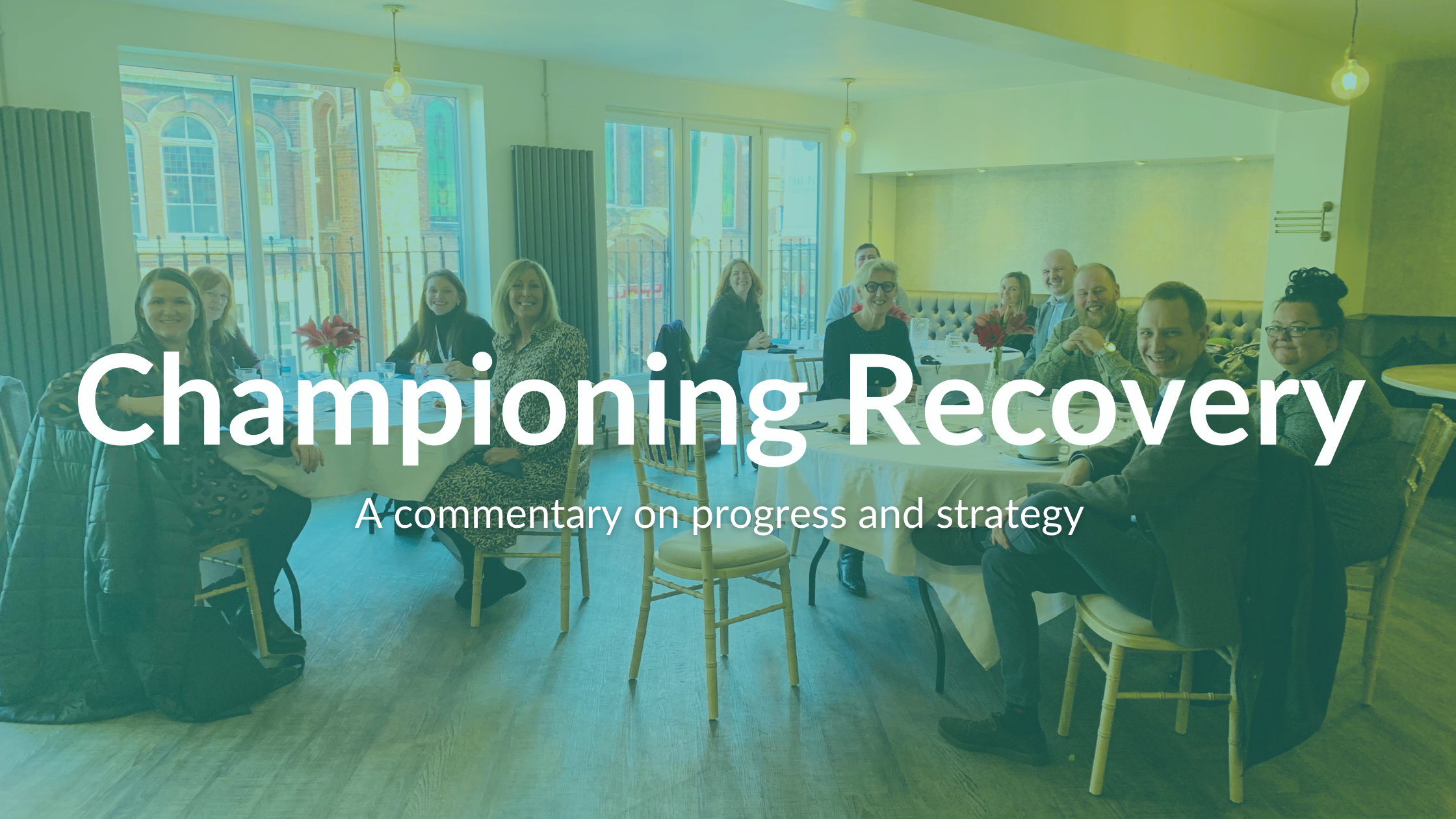
Last week, we welcomed the 10-year “From Harm to Hope” strategy, detailing the allocation of an additional £780m in funding across the sector. Plus, we were delighted to receive visitors from Project ADDER, including Rosanna O’Connor, into Middlesbrough as they visited local recovery organisations (see featured image).
And this week the government’s own Recovery Champion, Dr. Ed Day, updated his annual report reflecting where national strategies around recovery stand.
The “current state of recovery”
Reflecting on 20 years of progress and challenge, including cuts to Local Authority funding, the report highlights the excellent work of third sector organisations, and peer-led communities, from 2000 – 2020.
This, of course, takes us right up to the time of Dame Carol Black’s Independent Review of Drugs, published last February. Amongst the many key findings that report, relevant to our own work, were the following:
The number of residential rehabilitation services has reduced significantly, removing a core treatment component for those that need it to support their recovery.
Recovery is much wider than just substance use treatment with many drug users having multiple complex needs in terms of health (both physical and mental), employment, homelessness and offending.
There is significant local variation, but outcomes tend to be worse in the north of the country and particularly in the North East, often these areas have higher rates of opiate and crack use and higher rates of drug related mortality.
A positive path for movement
From the perspective of Ed Day, it became clear that alongside such significant findings, that there was also no clear method, at government level, of surveying 1) users of treatment services 2) people in early recovery, and 3) those with lived experience of developing peer-led services.
This, of course, is where organisations like Recovery Connections have been able to provide assistance, and demonstrate positive outcomes. It was recognised that the mutual support and community engagement provided by LERO’s was effective in sustaining engagement with recovery – and subsequently a national ‘Recovery Connectors’ group, of which our CEO, Dot Smith, is a member, was set up.
Crucially though, it has now been acknowledged that peer-led support services have not been utilised efficiently for research purposes, as part of what the government defines as ‘Recovery Oriented Systems of Care’ (ROSC). To this, we look forward to working with UK researchers to explore how the unique approach and effective work of peer-led services, and LERO’s, is recognised and communicated.
Ultimately though, we welcome Dr Day’s conclusion that both living and lived experience of problematic substance use is fundamental in making progress with the way it is treated, researched, funded, and reported in society. That two such positive updates at government level have been released, within one week of each other, bodes well for the future of our work.
Dr. Ed Day is a Clinical Reader in Addiction Psychiatry, at the University of Birmingham, and an ambassador of our students in recovery project, www.heartoncampus.co.uk.