Building Recovery in Middlesbrough: Momentum, Leadership and a Growing Regional Movement
In January, leaders from civic, statutory, community and business sectors gathered at 131 The Venue for Building Recovery in Middlesbrough: A Vision for 2026. The event brought together people with a shared commitment: to strengthen Middlesbrough’s role an Inclusive Recovery City and explore how recovery can become more visible, connected and embedded across the town.
What emerged on the day was far more than a conversation. It was the beginning of a collective commitment – one rooted in shared purpose, community strength and a belief that recovery is central to a thriving Middlesbrough. And this is something that was signed officially into the town’s plans almost three years ago.
Middlesbrough became the UK’s first Inclusive Recovery City in 2023, launching the news at The Riverside Stadium and outlining a vision built on visibility, partnership and community‑led recovery. Since then, Recovery Connections has remained closely involved in the wider IRC movement – sharing learning, contributing to national conversations, and providing guidance to organisations and public bodies exploring how to adopt or embed inclusive recovery principles.
This year, that work has been strengthened by new developments such as Clear Nights, a monthly alcohol‑free evening designed to offer meaningful, welcoming social spaces at Connections Community Café. And momentum is also reflected across Recovery Connections’ seven locations, all of which are working towards developing their own local IRC approaches. Teams from across all sites were together in January for the annual staff awards event, this time attended by more than 300 people, reflecting both the growth of the organisation, and the IRC movement.
On the day Middlesbrough became an Inclusive Recovery City, in 2023, the local Mayor, Chris Cooke, was in attendance. On his very first day in office, he signed the Inclusive Recovery Cities Charter, and made it official. This year, local MP, Andy McDonald, was present to add his thoughts and influence to the event.
Recovery as a Driver for Stronger Communities
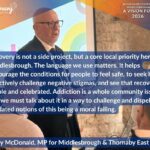
“Recovery strengthens families, boosts engagement in communities, increases workforce participation, and builds pride in place. It is the driver of community regeneration. When we invest in recovery, we invest in reducing long-term public costs, while improving wellbeing across the whole town. The inclusive recovery model reinforces the idea that recovery is everyone’s business — and everyone benefits when it succeeds.” – Andy McDonald MP for Middlesbrough & Thornaby East, Guest Speaker
A Growing Movement: From One Event to Regional Momentum
The January event closed with a clear sense of energy. People didn’t just attend — they volunteered to stay involved. That commitment has shaped the next steps.
On 19 March, Recovery Connections hosted the first Building Recovery in Middlesbrough Board Meeting, bringing together those who stepped forward to guide the next phase of the project. The newly-formed group represents a broad mix of public health leaders, civic voices, lived experience practitioners, business representatives and community partners.
Looking Forward: Leadership Rooted in Community
“What we saw in that room wasn’t just interest — it was commitment. People stepped forward because they want to play a part in shaping what recovery looks like across Middlesbrough and beyond. Our first Board meeting on 19 March will build on that energy, and it’s only the beginning. With plans for similar events in Stockton, Darlington, Hartlepool, Sunderland, Redcar and Gateshead later this year, the movement is growing across the region. Recovery has always belonged to communities — now those communities are coming together to lead the next chapter.” – Dot Smith, CEO, Recovery Connections
The story of Building Recovery in Middlesbrough is ultimately one of partnership. It shows what becomes possible when lived experience, public health, civic leadership and community voices come together with purpose.
As the IRC movement continues to grow locally, regionally and nationally, Middlesbrough remains a leading example of what happens when a town chooses to place recovery at the heart of its identity, future and culture.